

Introduction
Over the past 50 years, the Gaia Theory by James Lovelock has proved to be a point of controversy among people who believe it and people who don’t. The theory is that the Earth operates as a self-regulating system that will balance itself so life can exist on it. This piece will talk about the Gaia Theory’s creator and explain what it is. It then outlines the pros and cons of the theory to allow you to draw your own conclusions. Then it will finish by answering more specific questions such as ‘How can the Gaia Theory help us understand anthropogenic climate change?” Concluding with my own personal opinions on the theory.
Who is James Lovelock?

Lovelock was a British ecologist who was born on July 26, 1919 and made major contributions to the scientific community during his long life (he lived to the age of 103). One example is the electron capture detector, an inexpensive instrument that measures small anthropogenic compounds in the atmosphere. This device aided massively in the environmental industry as governments and councils were able to afford and install them all around their cities. This provided live data on the atmospheric composition in their local and suburban areas. Allowing them to introduce new laws to reduce levels of particulates and gases. But J. Lovelock is most well-known for his work on the Gaia Theory. (Schneider, 2022)
What is the Gaia Theory?
Lovelock started formulating the idea in September 1965 while working at the Jet Propulsion Laboratory in California to aid in methods of detecting life on Mars (Harvard University, 2010). The Gaia Theory is a hypothesis proposed by Lovelock and Lynn Margulis in 1972 and discusses how the Earth can be viewed as its own self-regulating organism that aims to keep the Earth in a state of stability, whether that applies to global temperatures or ocean salinity. These and other factors all play a major role in allowing life to flourish on our planet.
Reasons for Supporting the Gaia Theory
Lovelock’s books pose three main arguments for the Gaia theory.
- Even with humanity’s great leaps in technology, we are yet to find a planet that is as favourable to life as Earth. Research published in the Royal Astronomical Society suggests Earth-like conditions are much rarer than previously thought. Out of the 4,422 exoplanets that have been discovered by astronomers, only a handful have possible habitable conditions (Carter, 2021). This forms an argument that the Gaia Theory is unique to Earth, as if the theory were common or had the components for it to be a thing, surely more planets would be in a state in which life is able to survive for a long period of time.
- Over a geological time span, life has greatly altered the Earth’s environment, from the atmosphere to the hydrosphere. This shows evidence for the Gaia Theory, as completely different spheres can alter one another over time. A supporting example is the biosphere changing the concentration of CO2 in the atmosphere through photosynthesis, therefore reducing the greenhouse effect, which is the sun’s energy getting trapped around the Earth by what is known as “greenhouse gases,” which will slowly decrease the average global temperature.
- When looking at temperature or atmospheric composition over the past few thousand years, you can see that both have remained stable, with small fluctuations sometimes caused by global events such as volcanic eruptions.
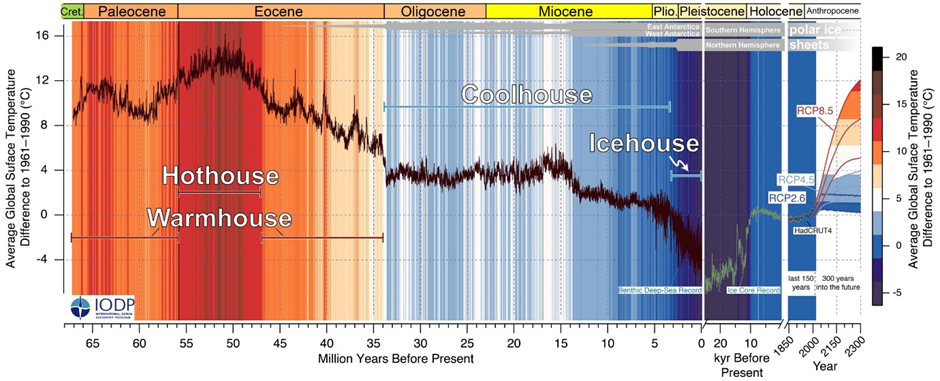
Figure 2 shows the Earth’s surface temperature for the past 65 million years. Yes, the temperature does fluctuate slightly every 10,000 years, but this is the Gaia Theory working to keep temperatures at a safe level for life. However, there has been a larger undulating pattern over a few million years, from about a 12-degree increase 50 million years ago to a 4-degree increase 34 million years ago. This is due to natural causes such as the Milankovitch cycles, El Nino, solar irradiance, and super volcanoes erupting. (Met Office, 2022).
- The Milankovitch cycle refers to the change in the Earth’s tilt and its path around the sun. Minor changes in these can lead to large changes in the Earth’s temperature. But these happen over a period of tens or hundreds of thousands of years, which is why we can see ups and downs in Figure 2. (Russell Deitrick, 2018)
- El Nino refers to the warming of the surface of the ocean in the eastern equatorial Pacific. Countries in the Eastern Pacific experience warmer weather. (Bromwich, 2015)
- Solar irradiance refers to the amount of solar energy (mainly from the sun) that hits our planet. These figures can fluctuate depending on the sun’s intensity, time of day, and distance from the equator. (Addison, 2008)
Reasons against the Gaia Theory
Richard Dawkins, an evolutionary biologist from Britain, argued against the Gaia Theory, as he pointed out that if you consider oxygen production from plants as pro-Gaia, then a mutated plant that did not produce oxygen would have less competition and therefore would have an advantage. Such a mutated plant “would out-reproduce its more public-spirited colleagues, and genes for public-spiritedness [within those colleagues] would soon disappear” (Dawkins, 1982). This problem with mutated plants is widely discussed among evolutionary biologists.
Lenton and Latour from the UK’s University of Exeter and Sciences Po in France, respectively, both think there should be an update to the Gaia theory (“Gaia 2.0” has been the proposed name). This updated version would incorporate mankind’s self-awareness when it comes to the impact we have on our planet (Lenton & Latour, 2018). So, they don’t necessarily disagree with the first theory; they just think that, given it was published 50 years ago and our advancements in technology are giving us a better understanding of our effects on the planet, it is better to include our updated awareness in a new theory because, whether we like it or not, we may cancel out all the benefits associated with the Gaia theory, such as its suggested ability to regulate the Earth’s climatic conditions to aid life.
How does the theory affect humans’ understanding of the Earth as a single system?
The Gaia Theory suggests that the Earth is a fully self-regulating single system. This means small changes to one part of our planet’s system can have long-reaching effects on others; for example, a report from Boston University claims that “City Trees and Soil are Sucking More Carbon Out of the Atmosphere Than Previously Thought” (Colarossi, 2022). Yes, the report does indicate it is not a result of the increase in concentration in the atmospheric CO2 but rather the increase in ‘edge forests,” which are small, narrow forests that you find between housing estates or fields. The reason this is important to understanding the Earth as a single system is that if a large forest were to burn down, the edges (i.e., any trees within 30 metres of the border of the forest) would receive a greater concentration of sunlight and, therefore, could grow at a much faster rate, meaning that they would take up more carbon dioxide. Over the course of a few years, the increased uptake of CO2 would not be able to offset the increase in CO2 from such a fire; however, over the course of a few hundred years, the Earth’s system would eventually settle.
Continuing with the example of the forest fire, After a fire has been extinguished, the nutrients that were stored in burnt trees are released back into the soil, which allows new vegetation to sprout again, showing that the Earth acts as a single system that has multiple mechanisms to restore balance. The sprouting vegetation absorbs some of the CO2 that was released during the forest fire, and in time (roughly 30 to 40 years depending on the age of the forest that was burned), all of the CO2 will have been reabsorbed, making it carbon neutral.
How can the Gaia Theory help us understand anthropogenic climate change?
But saying that the Earth is or acts like a self-regulating thing that always tries to restore balance can cause other problems in and out of the scientific community. An example of such a problem is that people are now less concerned about the effects of climate change, as some who know of the Gaia Theory believe it is the answer to all our problems.
However, such complete confidence in the Gaia Theory may be overconfidence. The Gaia Theory has the ability to keep conditions on this planet at a suitable level for life to thrive within Gaia’s own limits. Recognition that it has limits is vital, and a simple graph (Figure 3) showing the parts per million of carbon dioxide in the atmosphere can indicate just how far we have veered from our planet’s usual cycle.
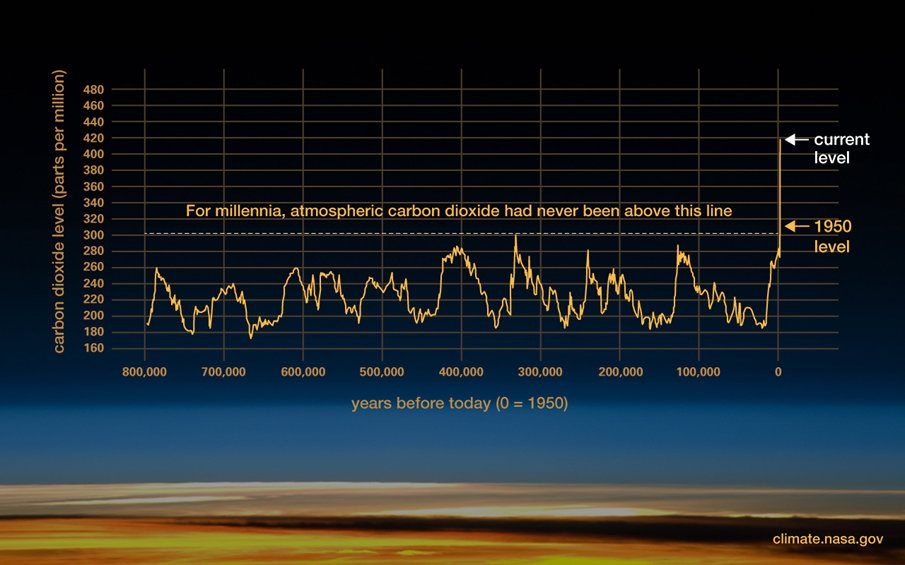
Figure 3 shows an increase of around 110 parts per million since the last recorded peak, some 340,000 years ago. While over a geological timescale, the Gaia Theory may be able to manage this sudden increase in CO2 levels, over a human lifespan, it may not solve all our climatic problems.
Can the Gaia Theory be categorically right or wrong?
The answer to whether the Gaia Theory is right or wrong is a topic that is heavily debated among scientists, as they all have their own opinions. Most of them will accept the “for” and “against” examples covered above. However, the fact that there are so many different opinions proves that we, as a species, don’t know enough about this hypothesis to draw a concrete conclusion. Our knowledge and understanding of the Gaia Theory will improve over time as we continue to make advances in technology.
What does it mean for the future of our planet?
In theory, Gaia can aid humans in tackling the effects of climate change. But as we look at figure 3, we can see that in the past 800,000 years, we have reached an all-time peak in terms of parts per million of CO2 in the atmosphere. But I don’t think the planet will be able to balance the rapid increase in CO2 that we have been seeing due to humans burning fossil fuels. Furthermore, I don’t see our consumption patterns changing much over the next few years, so the difference would be much greater than it is now.
However, I believe that over the course of a few million years, the Earth will become stable (in terms of the amount of CO2 in the atmosphere). But for this to happen much sooner, the Earth would have to experience one of the four major events discussed earlier in this essay to reach pre-industrial levels of CO2.
Conclusion
Overall, I believe the Gaia Theory to be a plausible explanation for the stable conditions our planet has been experiencing for such a long period of time. I believe this to be the case, as even with our advancements in technology, we have yet to find a plant with any life at all. This may mean that planets need certain conditions not only for life to begin but also for the Gaia Theory to start. Furthermore, there is statistical evidence that the Earth’s temperature has been kept at a stable level for hundreds of years, further proving that some balancing act goes on. However, I do not believe Gaia will be the answer to all climatic problems, as it does not work on a short timescale but rather a geological timescale. But showing that there are multiple arguments for the theory proves that the topic is still heavily debated and that there is no right or wrong answer.
Bibliography
Addison, K., 2008. NASA : Solar Dynamics Observatory. [Online]
Available at: https://www.nasa.gov/mission_pages/sdo/science/Solar%20Irradiance.html
[Accessed 11 December 2022].
Bromwich, J. E., 2015. Understanding El Nino, New York: The New York Times.
Cameron, S. D., 2010. James Lovelock – Discovering Gaia [Interview] (January 2010).
Carter, J., 2021. There is Only One Other Planet In Our Galaxy That Could Be Earth-Like, Say Scientists. [Online]
Available at: https://www.forbes.com/sites/jamiecartereurope/2021/06/23/there-is-only-one-other-planet-in-our-galaxy-that-could-be-earth-like-say-scientists/?sh=9b53caa53df4
[Accessed 10 December 2022].
Colarossi, J., 2022. City Trees and Soil Are Sucking More Carbon Out of the Atmosphere Than Previously Thought, Boston: Boston University.
Dawkins, R., 1982. The Extended Phenotype. 1st ed. Oxford: Oxford University Press.
Freedman, B., 2022. Gaia Hypothesis, s.l.: Science Encyclopedia.
Harvard University, 2010. Gaia Hypothesis, Boston: Harvard University.
Henderson-Sellers, A. & McGuffie, K., 2012. Chapter 18 – Future Climate: One Vital Component of Trans-disciplinary Earth System Science. In: M. Rice & A. Henderson-Sellers, eds. The Future of the World’s Climate (Second Edition). 2nd ed. s.l.:Elsevier Science, pp. 509-529.
Horton, H., 2022. James Lovelock, creator of Gaia hypothesis, dies on 103rd birthday. [Online]
Available at: https://www.theguardian.com/environment/2022/jul/27/james-lovelock-creator-of-gaia-hypothesis-dies-on-103rd-birthday
[Accessed 9 December 2022].
Lenton, T., 2003. Gaia Hypothesis, Edinburgh: Elsevier .
Lenton, T., 2019. Time Lenton interviews Jame Lovelock [Interview] (July 2019).
Lenton, T. M. & Latour, B., 2018. Gaia 2.0. Science, September, pp. 1066-1068.
Lovelock, J., 2022. James Lovelock – Originator of Gaia Theory and inventor of the electron capture detector. [Online]
Available at: http://www.jameslovelock.org
[Accessed 10 December 2022].
Met Office, 2022. Causes of climate change. [Online]
Available at: https://www.metoffice.gov.uk/weather/climate-change/causes-of-climate-change#:~:text=Natural%20influences%20on%20the%20climate,and%20warmer%20periods%20(interglacials).
[Accessed 8 December 2022].
MuchAdoAboutClimate, 2013. 4.5 Billion Years of Earth’s Temperature. [Online]
Available at: https://muchadoaboutclimate.wordpress.com/2013/08/03/4-5-billion-years-of-the-earths-temperature/
[Accessed 8 December 2022].
Osborne, H., 2018. Gaia Hypothesis: Humans Have Fundamentally Altered Earth’s Self-Regulation System. [Online]
Available at: https://www.newsweek.com/gaia-earth-self-regulation-altered-human-awareness-1119921
[Accessed 9 December 2022].
Ruse, M., 2013. Earths’s holy fool?, s.l.: Aeon.
Russell Deitrick, R. B. T. R. Q. J. A. B. C. &. C. W., 2018. Exo-Milankovitch Cycles. I. Orbits and Rotation States. The Astronomical Journal, CLV(2), p. 60.
Schneider, K., 2022. James Lovelock, Whose Gaia Theory Saw the Earth as Alive, Dies at 103. The New York Times, 27 July, p. 21.
Swansea University, 2022. Understanding How Forest Fires Affect Carbon Emissions and Climate Change. [Online]
Available at: https://www.swansea.ac.uk/research/research-highlights/sustainable-futures-energy-environment/wildfires/
[Accessed 10 December 2022].
The Guardian, 2021. Beware: Gaia may destroy humans before we destroy the earth. The Guardian, 2 November.
Trenberth, K. E., 1997. The Definition of El Nino. Bulletin of the American Meteorological Society, LXXVIII(12), pp. 2771-2778.
University of California – Santa Cruz, 2020. 66 Million Years of Earth’s Climate History Uncovered – Puts Current Changes in Context. [Online]
Available at: https://scitechdaily.com/66-million-years-of-earths-climate-history-uncovered-puts-current-changes-in-context/
[Accessed 8 December 2022].


+ There are no comments
Add yours