

The world is confronting a significant upcoming challenge as the impacts of climate change become increasingly evident to a growing number of people. Governments are endeavouring to identify alternative energy sources with lower carbon emissions. The transition to green and renewable energy has been a prominent part of the agendas of most developed countries in the past decade, particularly considering the conflict in Ukraine, which exposed Europe’s dependence on Russian fossil fuels for electricity generation and heating.
The discussion then turns to the quest for the optimal energy source to replace fossil fuels. The popular choices include wind, hydro, solar, and geothermal energy. However, all these renewable sources require specific conditions to be maximally effective:
- Wind energy necessitates large open spaces, with larger turbines yielding better results.
- Hydro energy demands ample space with a high and dependable volume of water.
- Solar energy thrives in areas with copious sunlight and is more efficient closer to the equator.
- Geothermal energy relies on access to thermal heat vents.
So, where does nuclear energy fit into this scenario? Nuclear power isn’t a renewable energy source, as its fuel, typically uranium, is not in unlimited supply. Nevertheless, this doesn’t mean that nuclear power emits greenhouse gases—far from it. Except for the construction of the facility housing the nuclear reactor, it is a carbon-free form of energy. As with everything in the world, it comes with its own set of advantages and disadvantages, which I will delve into further.
How It Works
Before we can make a case for both sides of nuclear energy, it’s essential to understand how a nuclear reaction functions. There are two types of nuclear reactions: nuclear fission and nuclear fusion, but currently, humanity has only perfected fission. Fusion, the process occurring in all stars, including our Sun, consumes 4.7 million tons of hydrogen per second (Lea, 2023).
According to the Office of Nuclear Energy, “Fission occurs when a neutron collides with a larger atom, causing it to become excited and split into two smaller atoms—known as fission products. Additional neutrons are also released, capable of initiating a chain reaction” (Office of Nuclear Energy, 2021). Each atom’s split releases a significant amount of energy. This energy is transferred to water constantly circulating the reactor, heating it enough to turn it into steam, which then drives a turbine connected to a generator, converting kinetic energy into electrical energy.
Challenges
Cost
Nuclear power plants are by no means a cost-effective source of energy. For example, Hinkley Point C, a nuclear power plant under construction in the United Kingdom, is projected to cost around £31 to £32.7 billion ($37.2 to $39.3 billion), a substantial sum for any country, including the United Kingdom. This makes nuclear energy a resource-limited to nations with the financial capacity to construct such plants. According to Statista, there are currently 436 active nuclear reactors worldwide (Statista, 2023):
- Asia – 185
- Europe – 129
- North America – 112
- South America – 8
- Africa – 2
The United States has 93 reactors in operation, compared to 22 in India and 9 in the United Kingdom.
Radiation
The most significant concern associated with nuclear energy is radiation, particularly radiation leaks from nuclear power plants, which have been responsible for notable incidents over the past few decades. I will discuss some of the most well-known cases later. But what exactly is radiation, and why are people apprehensive about it?
In nuclear power plants, a specific type of radiation, “ionizing radiation,” is emitted. This form of energy is released during the fission process and is associated with uranium. According to the Centers for Disease Control and Prevention (CDC), “Ionizing radiation is a type of energy that acts by stripping electrons from atoms and molecules in materials, including air, water, and living tissue. Ionizing radiation can travel unseen and penetrate these materials” (CDC, 2021). This implies that if there are leaks in a nuclear reactor, this perilous natural phenomenon can irradiate all living organisms nearby.
Disposal
One of the most challenging aspects of nuclear energy is managing the residual fuel after it has been used, as it remains highly radioactive. Major facilities must be constructed to securely store nuclear waste, keeping it out of sight. Designers must also consider the half-life of nuclear fuel, often exceeding 100,000 years. Consequently, specific signs and symbols are placed on the ground above these facilities to dissuade future generations from disturbing the soil (Benke, 2023)
Reliance on cooling
Public perception of accidents such as Fukushima and Chernobyl
Fukushima:
Fukushima is one of the most famous nuclear disasters to ever occur. The primary reason for this disaster was a magnitude 9.0 earthquake that occurred on Friday the 11th of March 2011 which would go on to be named “The Great East Japan Earthquake”. This major earthquake took place 130km off the Japanese coast and caused the main Japanese island of Honshu to move 2.4 meters east. The subsequent tsunami inundated about 560 km2 leading to 19,500 deaths and over a million collapsed buildings. The nuclear plant was built 10 meters above sea level and its sea water cooling pumps 4 m above sea level. There was no apparent damage as a direct result of the earthquake in fact reactors 1 through 3 were automatically shut down which they are designed to do when an event like this happens. However, it is important to know that even though three of the reactors were shut down it was still of paramount importance to keep them cool. The earthquake caused all six external power supplies to be lost because of the damage to the region’s infrastructure. As a result, the emergency diesel generators which are in the basement of the turbine hall started up.
42 minutes later the first Tsunami hit followed by the second a mere eight minutes later. The 16 to 17m wave breached all the facilities’ barriers and submerged, and damaged, the seawater pumps for the main condenser circuits and the auxiliary cooling circuits. This resulted in reactors one to three being put into a dire situation which caused an evacuation while engineers tried to restore cooling. All three reactors had battery backups however reactors one and two were flooded and reactor three only had about 30 hours of power remaining. At 7:03 pm on Friday, the 11th of March a nuclear emergency was declared, and an evacuation order was issued for those within 2km of the plant. By Sunday the 12th of March the zone had been extended to 20km.
To try and cool the core they started pumping seawater into all three of the reactors. It was said that in reactor one it took only 1 and a half hours for the reactor fuel to evaporate all the pumped water away. Furthermore, the exposed fuel rods reached temperatures of 2,800 °C (5,072 °F) causing the fuel to melt down to the base of the Reactor Pressure Vessel (RPV). A similar situation took place in reactors two and three but to a lesser extent than in reactor one. As pressure grew in rector one the team decided to vent some of the steam out into the atmosphere. However, the vented steam, noble gases, and aerosols were accompanied by hydrogen leading to a hydrogen explosion at 3:36 pm on Saturday 12th which destroyed the top part of the building. The nuclear fuel was believed to be at the bottom of the RPV, but it was later found it had eroded 65cm into the drywell concrete below (which is 2.6 m thick). Luckily there was little to no radioactive contamination because of this explosion.
On the morning of Monday, the 14th further PCV venting took place at reactor 3 however this back flowed to the service floor of the building leading to a “very large” hydrogen explosion that blew off most of the roof and walls of the unit. Lots of debris was created as a result of the explosion some of it was extremely radioactive. The following day saw another explosion this time at unit 4. The upper portion of Unit 4’s building was destroyed, and the debris produced damaged Unit 3’s superstructure further.
The radioactive release peaked on Tuesday 15, mainly from unit 2. Nuclear and Industrial Safety Agency said in June that it estimated 800-1000km of hydrogen had been produced in each unit at the plant.
On the 4th of April 2011, radiation levels were recorded at 0.06 mSv/day (Millisieverts) some 65km northwest of the plant.
In 2023 there have been many reports of Japan wanting to release contaminated nuclear water back into the ocean. They want to do this to make way for new facilities to fully decommission the nuclear plant.
Chernobyl:
Chernobyl is without doubt the most famous example of what can go wrong with nuclear power generation. It was an event that took place over 37 years ago on the 26th of April 1986 close to the former city of Pripyat and 81 miles (130 km) north of Kyiv in what was the Soviet Union at the time of the disaster. It was a combination of misinformation and a thirst for power that led to the infamous event occurring.
On the 25th of April 1986, a routine maintenance test was due to take place that would find out if the power plant workers would be able to use the last bits of kinetic energy left in the turbines to power the main circulating pumps for the short time it takes for the diesel generators to come online in the event of the plant losing mains power supply. This test was meant to have taken place before, but the workers were never able to successfully complete it. The team disabled many elements of the reactor, to get it in an appropriate state for the test, including some safety features such as the automatic shut. The shutdown of the reactor was delayed further when the grid controller refused to allow the plant to fully shut down as power was needed for the grid. Therefore, the reactor was kept at half-power for a significant period during which time, about an hour at half-power, the ECGS (Emergency Core Cooling Systems) was switched off.
For the test, the reactor was meant to be held at around 700 to 1000 MWt prior to shut down but in this case, that figure sat at around 30 MWt at 00:28 on 26th April. The plant controllers were aware of this and tried several ideas to increase the power output to the 700 to 1000 MWt required. However, because the reactor was being held at half power for such a long period of time, Xeon had built up in the base of the core. When the reactor is operating at full power Xeon production is balanced out by the reaction rate. This led to what is known as xenon poisoning which makes it extremely difficult to raise power in such circumstances.
Further problems such as reduced coolant void and graphite cooldown cause the plant workers to start withdrawing control rods to try and balance out the reactivity with these effects. After all of the back and forth as the operators tried to salvage as much power as possible at 1:03 on the 26th of April the power level from the reactor read at 200 MWt and it was decided that the test would go ahead.
It has been calculated that only eight control rods were left inside the reactor core, the minimum required for the test where 15, but nevertheless the test went ahead. As the turbines slowly spun down and the pumps turned off the slower flow rate in the core and the warmer feedwater might have caused a boiling off at the bottom of the core. Another possibility is that the graphite at the bottom of the boron control rods adds to the reactivity further enhancing the effects I mentioned earlier. The control rods were inserted when one of the workers pressed the emergency scram button which was made to completely shut down the reactor. This led to a major increase in reactivity in the core causing a surge in power and within three seconds the reactor output had risen over 530 MWt.
Several things happened in the core of the reactor including the most important aspect which was the rupturing of several nuclear fuel rods. This caused the reactor activity to increase further because of an increase in steam which increased power. This pressure increase spurred on by the ruptured fuel rods led to enough of an increase in pressure that the 1000 t reactor support plate became detached which jammed the control rods in place. The depressurisation of the reactor caused a mass increase in steam generation which led to the first of two explosions. The second explosion, which was much bigger than the first, came only a few seconds later and it is believed to have occurred because of a build-up of hydrogen. This explosion launched nuclear fuel, moderator, and structural material all around the outside of reactor number four.
Valery Khodemchuk was the first to die. He is thought to have been in the reactor room moments before the explosion and was killed instantly. His body remains permanently entombed under the rubble of the reactor. (World Nuclear Association , 2019)
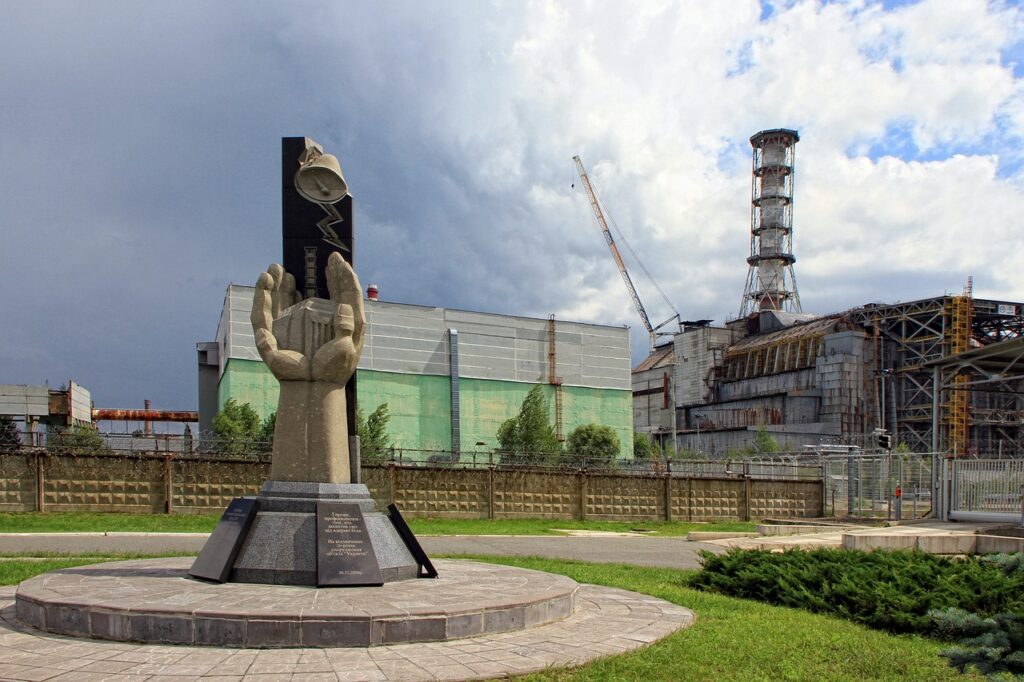
An exclusion zone was established around the ruined reactor as the Soviets brought in hundreds of thousands of men to assemble the ‘Sarcophagus’ around the open reactor. Mikhail Gorbachev, the leader of the Soviet Union at the time, once said
“Even more than my launch of perestroika, [Chernobyl] was perhaps the real cause of the collapse of the Soviet Union five years later.”
As of 2023, excluding the factor of the Russian invasion, Chornobyl is very safe and attracts many tourists each year. A new cover has been built over Reactor Four, at a cost of $1.4bn, to replace the weathered Sarcophagus. The new structure is fitted with cranes and will slowly dismantle and remove all the radioactive material left.
“The 1986 Chernobyl catastrophe that exposed some 10 million people to nuclear radiation in the surrounding countries has estimated costs of roughly $700 billion over the past 30 years, according to our extensive review of the literature,” said Jonathan Samet, Distinguished Professor and Flora L. Thornton Chair of the preventive medicine department at the Keck School of Medicine of the University of Southern California. (Cohen, 2016)
The pros
However nuclear power isn’t all bad as there are many reactors, some retired, that have been consistently pumping out power for decades without you knowing. So, what are the benefits of producing power in this way?
Power Generation
One point that is always important to mention is just how much power nuclear reactors can produce. For example, Hinkley Point C is predicted to produce around 7% of the UK’s electricity needs upon opening. But unlike other power generation methods such as hydro or solar nuclear is much more constant and will, in this case, produce 3,260MW of electricity for the next 60 years. So, the high upfront cost does have its benefits.
Clean/green energy
Apart from the possible carbon emissions in the construction process nuclear power does not emit greenhouse gases. Therefore, is pivotal in helping the world transition to a green future. Note that although the production is clean and does not emit greenhouse gasses there is a finite amount of nuclear material on earth therefore is not totally renewable.
Costs
As mentioned, the upfront costs of building these plants are astronomical however, the overall costs of running a nuclear power plant compared to a regular fossil fuel stream-powered plant are twice as much in operating costs, similar in maintenance, and four times less in terms of fuel costs. Meaning the overall cost of nuclear power in 2021 is cheaper with fossil fuel steam being 63% more expensive. (Energy Information Administration, 2021)
Safety
Most if not all of the most well-known/well-documented nuclear disasters have either occurred during the early days of nuclear power or as a result of extreme circumstances like earthquakes. Newer reactors particularly built in the west have numerous safety systems built in to make sure events like Chernobyl and Fukushima never happen again.
My personal Opinion
I personally think Nuclear Energy is one of the most vital components in helping transition nations towards carbon neutrality. However, when nuclear reactors go wrong the damage that they can cause to the people and landscape around them can be detrimental or in the most extreme cases globally disastrous. But the most well-known examples, Chernobyl and Fukushima, are “extremely” rare and only happened because of corner-cutting and extreme natural phenomena. Furthermore, when people talk about the negative aspects of nuclear power, they always mention nuclear waste when in fact, nuclear waste is 1/10,000th of the waste generated by solar and 1/500th of the waste generated by wind. (Matthews, 2022) Making the argument for which source is best deeper.
Conclusion
There is clearly no easy answer to the nuclear debate. As with anything, there are both pros and cons to either side. Nevertheless, the debate about its use will ensue for many years to come with the only possible catalyst to change the “anti-unclear” people out there may be the thing that they want to avoid. Climate Change.
References
Benke, E., 2023. Finland is on the verge of becoming the first nation to bury spent nuclear fuel rods deep underground for the long term. Erika Benke visits the Onkalo site to find out more.. [Online]
Available at: https://www.bbc.com/future/article/20230613-onkalo-has-finland-found-the-answer-to-spent-nuclear-fuel-waste-by-burying-it
[Accessed 18 July 2023].
CDC, 2021. The Electromagnetic Spectrum: Ionizing Radiation. [Online]
Available at: https://www.cdc.gov/nceh/radiation/ionizing_radiation.html#:~:text=radiation%2C%20click%20here-,What%20is%20ionizing%20radiation%3F,and%20pass%20through%20these%20materials.
[Accessed 24 June 2023].
Cohen, J., 2016. University of Southern California. [Online]
Available at: https://globalhealth.usc.edu/2016/05/24/the-financial-costs-of-the-chernobyl-nuclear-power-plant-disaster-a-review-of-the-literature/
[Accessed 2023].
Energy Information Administration, 2021. Average Power Plant Operating Expenses for Major U.S. Investor-Owned Electric Utilities. [Online]
Available at: https://www.eia.gov/electricity/annual/html/epa_08_04.html
[Accessed 2023].
Lea, R., 2023. What is the Mass of the sun?. [Online]
Available at: https://www.space.com/42649-solar-mass.html#:~:text=Using%20this%20method%2C%20Stanford%20University,of%20mass%20lost%20as%20energy.
[Accessed 18 October 2023].
Matthews, R., 2022. Change Oracle. [Online]
Available at: https://changeoracle.com/2022/07/20/nuclear-power-versus-renewable-energy/
[Accessed 2023].
Office of Nuclear Energy , 2021. Fission and Fusion: What is the Difference?. [Online]
Available at: https://www.energy.gov/ne/articles/fission-and-fusion-what-difference
[Accessed 23 June 2023].
Statista , 2023. Number of operable nuclear power reactors worldwide as of May 2023, by country. [Online]
Available at: https://www.statista.com/statistics/267158/number-of-nuclear-reactors-in-operation-by-country/
[Accessed 23 June 2023].
World Nuclear Association , 2019. Sequence of Events – Chernobyl Accident Appendix 1. [Online]
Available at: https://www.world-nuclear.org/information-library/safety-and-security/safety-of-plants/appendices/chernobyl-accident-appendix-1-sequence-of-events.aspx
[Accessed 2023].


+ There are no comments
Add yours